


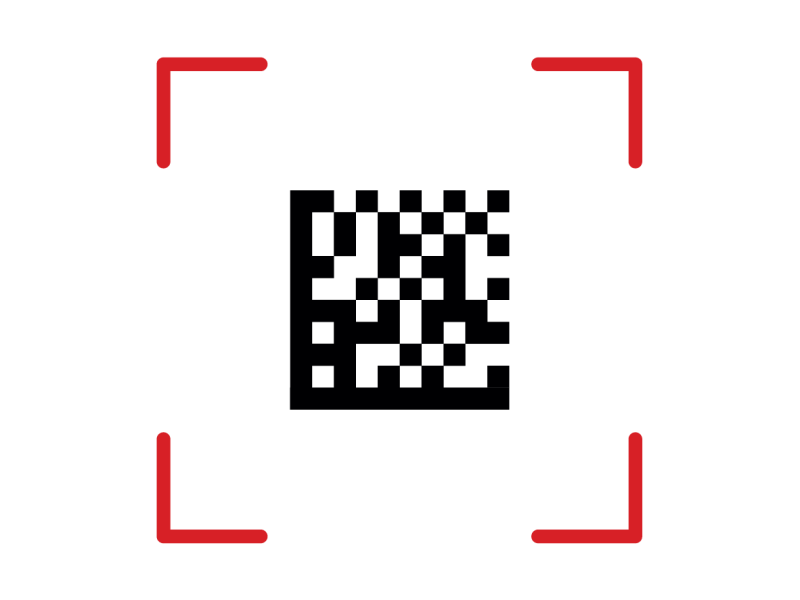
- Automatic detection of the code in the image
- Decodes ECC200, ECC000, ECC050, ECC080, ECC100 and ECC140 codes
- Computes quality indicators as per ANSI/AIM, ISO/IEC 15415, ISO/IEC TR 29158 and SEMI T10-0701 standards
- Very fast operation
- Impressive robustness to noise, blur and distortion
- Support of GS1 Data Matrix codes
- Efficient reading of codes in grid layout
- Multiple codes reading
Description
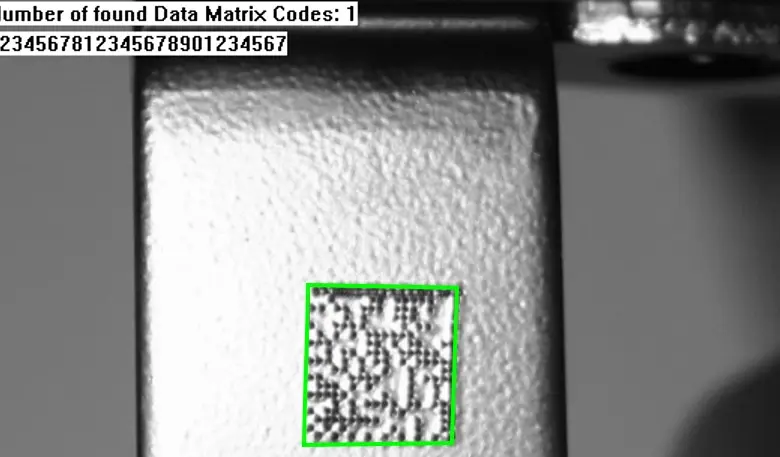
Automatic Recognition
As an automatic library, a learning phase is not required, but it is optional. Some characteristics of the matrix code may be set manually in order to restrict the search and accelerate the process. These characteristics are: the family of the matrix code, the number of cells, the cells color, whether flipping is allowed or not.
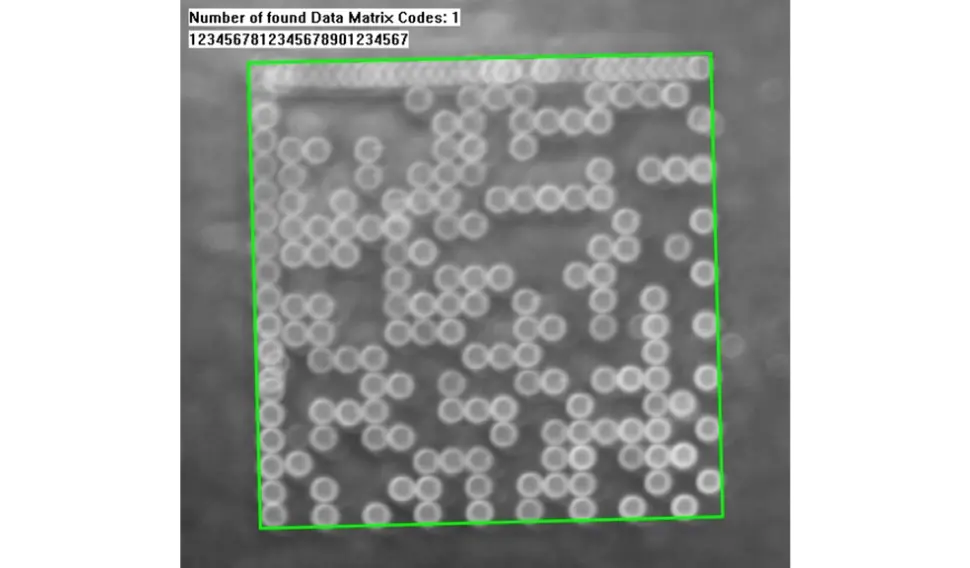
Impressive Robustness To Noise, Blur, And Distortion
EasyMatrixCode can be used in the most demanding situation. It has been designed to fulfill the most difficult application cases such as:
- Bad illumination conditions: non-uniform contrast, under- or over-exposed images
- Bad images resulting from printing or optical defects: blurred Data Matrix codes, anisotropic and non-uniform scaling, noisy images, skewed images
- Hard-to-detect codes: small-size codes, codes on a textured background, resulting from dot peening, laser marking, ink jet printing or electro-chemical etching on various materials
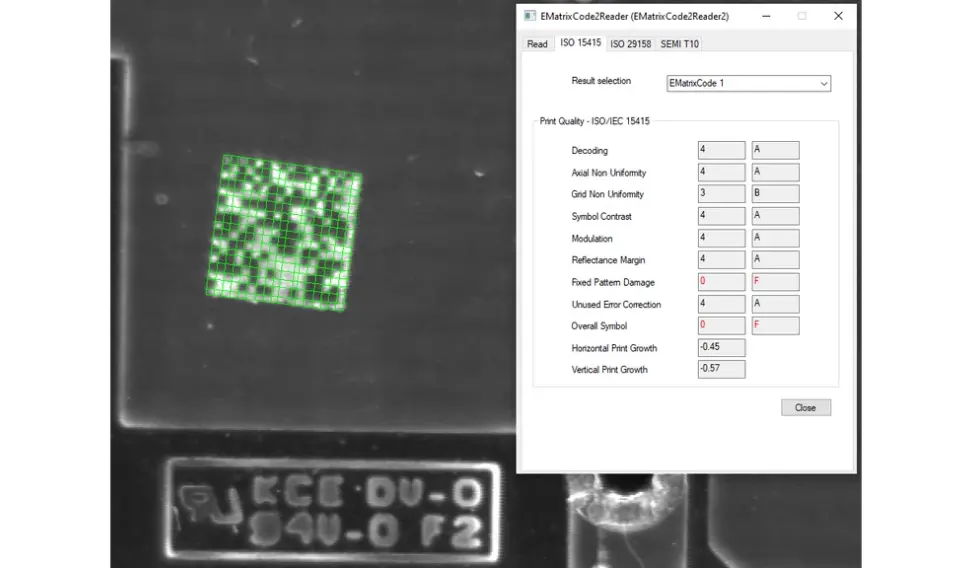
Print Quality Verification
EasyMatrixCode inspects the quality of the Data Matrix code and computes the indicators as defined by the ANSI/AIM, ISO/IEC 15415, ISO/IEC TR 29158 and SEMI T10-0701 standards.
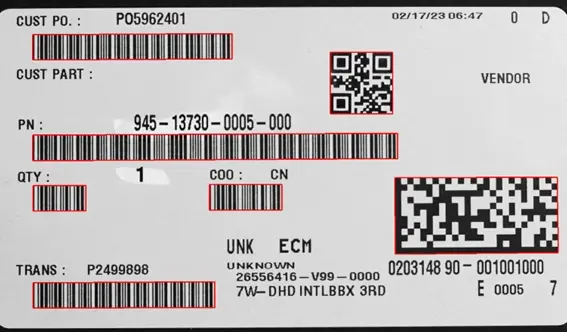
ECodeReader: More Codes In One Scan
ECodeReader simplifies the process of reading multiple codes and types within the same image by integrating EasyMatrixCode2, EasyBarCode2 and EasyQRCode into a single, simple, and unified interface. In some applications, reading multiple code types is a requirement. Doing so, required until now, the use of multiple Code Readers (i.e. one per code type). ECodeReader simplifies that process by integrating the power of EasyMatrixCode2, EasyBarCode2 and EasyQRCode into a single, simple, and unified interface. With ECodeReader, you can thus read Barcodes, Data Matrix codes and QR codes with a single method call. Note: ECodeReader requires the EasyMatrixCode, EasyBarCode and EasyQRCode licenses.
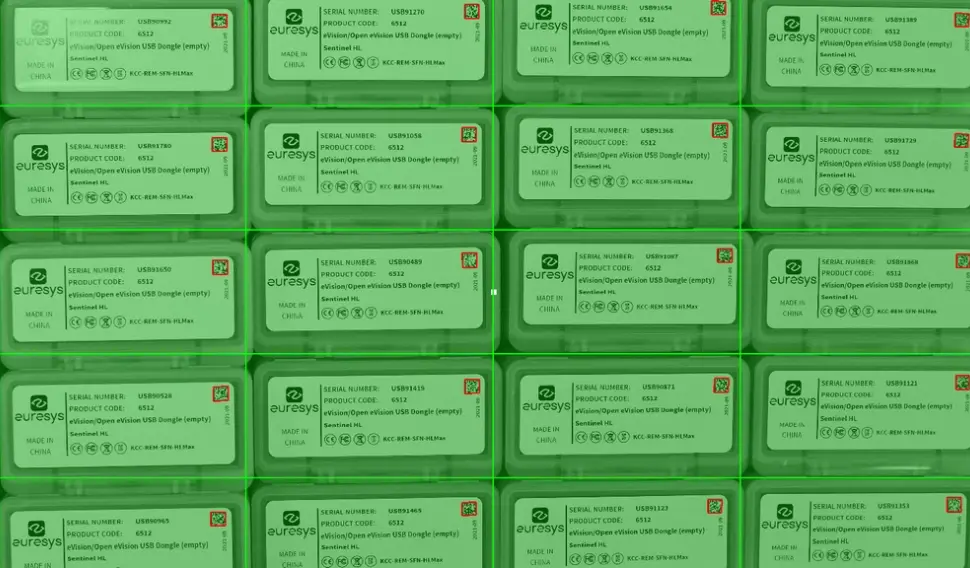
Grid Reading
EasyMatrixCode2 supports the definition of a grid to improve reading regularly positioned Data Matrix Codes. When possible, using a grid substantially improves both the reliability and reading speed.
Other Benefits
Neo Licensing System
Neo is the new Licensing System. It is reliable, state-of-the-art, and is now available to store Open eVision and eGrabber licenses. Neo allows you to choose where to activate your licenses, either on a Neo Dongle or in a Neo Software Container. You buy a license, you decide later.
Neo Dongles offer a sturdy hardware and provide the flexibility to be transferred from a computer to another. Neo Software Containers do not need any dedicated hardware, and instead are linked to the computer on which they have been activated.
Neo ships with its own, dedicated Neo License Manager which comes in two flavours: an intuitive, easy to use, Graphical User Interface and a Command Line Interface that allows for easy automation of Neo licensing procedures.
All Open eVision Libraries For Windows And Linux
- Microsoft Windows 11, 10 for x86-64 (64-bit) processor architecture
- Microsoft Windows 11, 10 IoT Enterprise on x86_64 systems
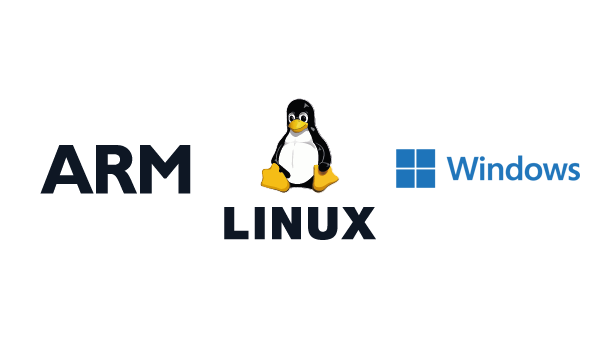
- Linux for x86-64 (64-bit) and ARMv8-A (64-bit) processor architectures with a glibc version greater or equal to 2.18
Open eVision Studio
Open eVision Studio is the evaluation, prototyping and development tool of Open eVision.
Its intuitive graphical user interface allows you to call and immediately see the result of any of eVision’s 2D image processing functions. A scripting functionality generates the corresponding code, which can then be copied and pasted into your application.
Open eVision Studio is free (when using Open eVision 2.0 and above) and does not require any license.



Software
- Host PC Operating System
-
Open eVision is a set of 64-bit libraries that require an Intel compatible processor with the SSE4 instruction set or an ARMv8-A compatible processor.
Open eVision can be used on the following operating systems:
Microsoft Windows 11, 10 for x86-64 (64-bit) processor architecture
Microsoft Windows 11, 10 IoT Enterprise for x86-64 systems
Linux for x86-64 (64-bit) and ARMv8-A (64-bit) processor architectures with a glibc version greater or equal to 2.18
Remote connections
Remote connections are allowed using remote desktop, TeamViewer or any other similar software.
Virtual machines
Virtual machines are supported. Microsoft Hyper-V, Oracle VirtualBox and libvirt hypervisors have been successfully tested.
Only the Neo Licensing System is compatible with virtualization.
Minimum requirements:
2 GB RAM to run an Open eVision application
8 GB RAM to compile an Open eVision application
Between 100 MB and 2 GB free hard disk space for libraries, depending on selected options.
- APIs
-
Supported programming languages :
The Open eVision libraries and tools support C++, Python and the programming languages compatible with the .NET (C#, VB.NET)
C++ requirements: A compiler compatible with the C++ 11 standard is required to use Open eVision
Python requirements: Python 3.11 or later is required to use the Python bindings for Open eVision
.NET requirements: .NET framework 4.8 (or later) or the .NET platform 6.0 (or later) are supported
Supported Integrated Development Environments:
Microsoft Visual Studio 2017 (C++, C#, VB .NET, C++/CLI)
Microsoft Visual Studio 2019 (C++, C#, VB .NET, C++/CLI)
Microsoft Visual Studio 2022 (C++, C#, VB .NET, C++/CLI)
QtCreator 4.15 with Qt 5.12
Ordering Information
- Product status
-
Released
- Product code - Description
-
PC4157 Open EasyMatrixCode for USB dongle
PC4307 Open eVision EasyMatrixCode
- Related products
-
PC6512 eVision/Open eVision USB Dongle (empty)
PC6514 Neo USB Dongle (empty)