


- Pattern matching using a feature point technology
- Learn from image or DXF vector model
- Fully automatic, fast and robust
- Invariant to rotation and scaling
- High tolerance to pattern degradation
- Support of "don't care" areas
Description
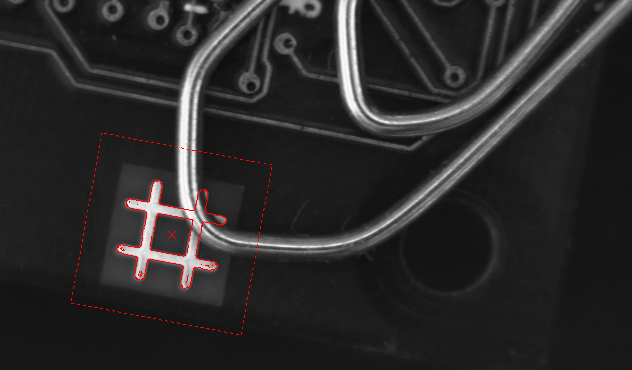
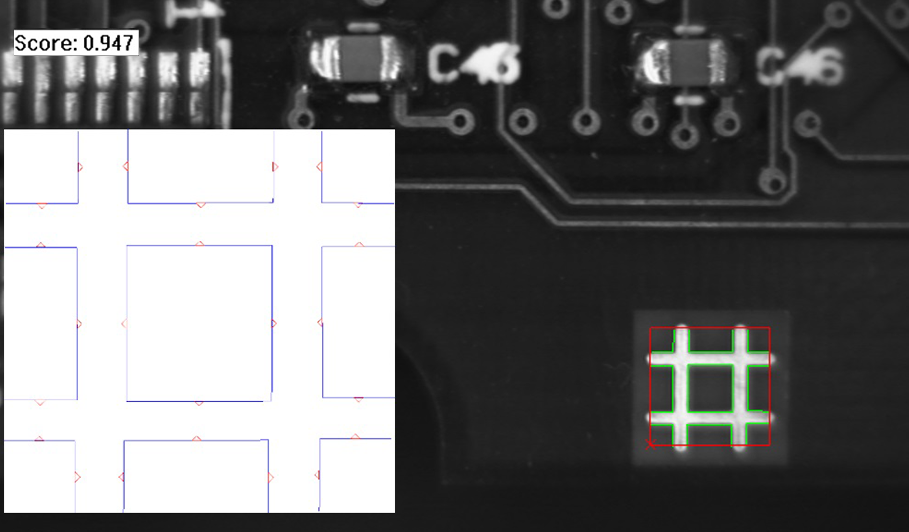
Based on an innovative feature-point technology, EasyFind is designed to rapidly find one or more instances of a reference model in the image. Compared to normalized correlation, EasyFind features faster processing and improved robustness. It shows excellent performances when handling instances that are highly degraded due to noise, blur, occlusion, missing parts or unstable illumination conditions.
Sub-Pixel Accuracy
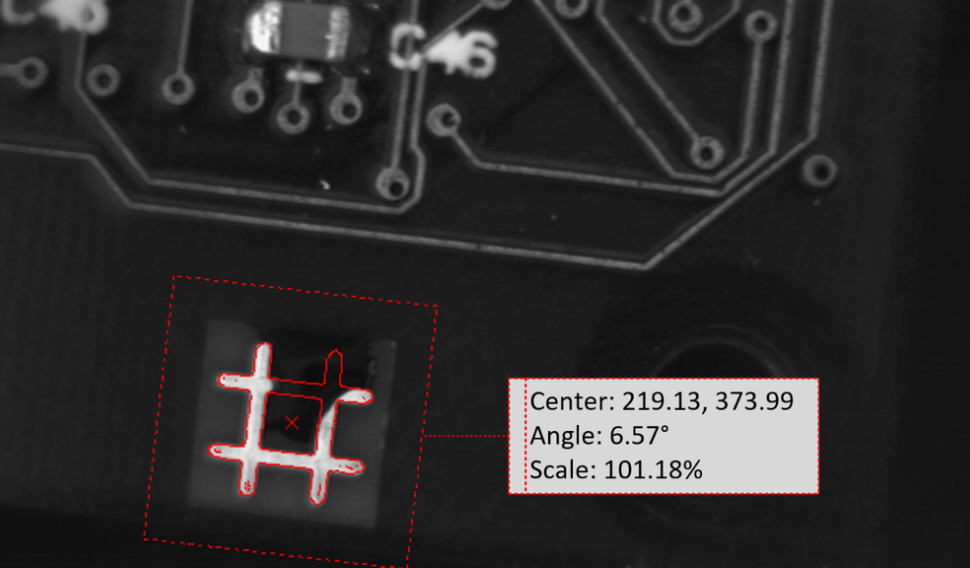
With an adjustable accuracy up to sub-pixel level, EasyFind reports very precise information about the instances found, such as their location, rotation angle, scale and matching score.
Fast Processing And Improved Robustness
EasyFind is based on a novel feature-point technology. Instead of comparing the reference model to the sample image pixel-wise, it carefully selects salient features in the model. This method allows EasyFind to match only the areas that convey valuable information, resulting in faster processing and much improved robustness.
“Don’t-Care” Areas
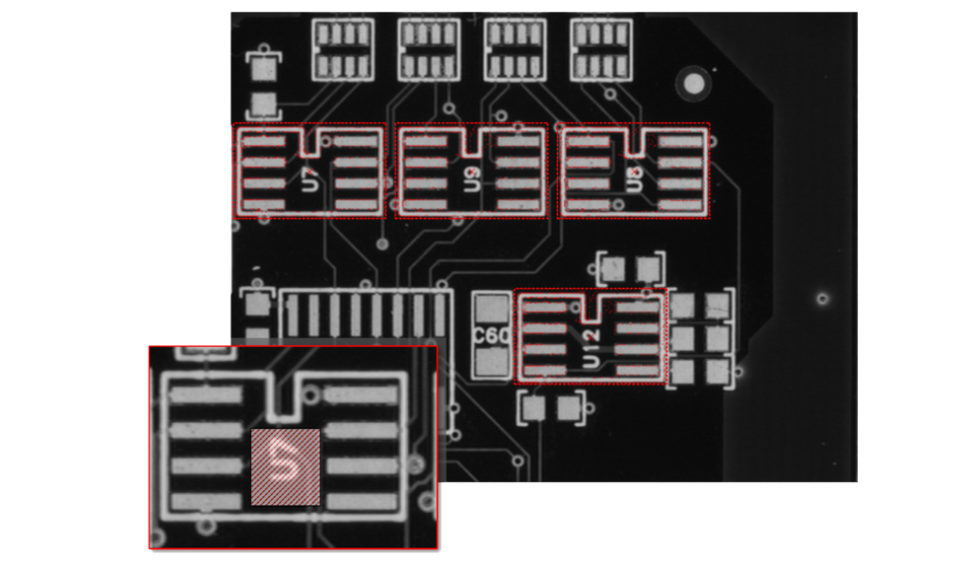
EasyFind supports “don’t-care” areas. This feature allows the creation of complex pattern shapes.
Training On Vector Patterns
In this mode, the learning is done on collections of 2D geometrical shapes rather than on rasterized patterns. The learning model is constructed using the new class EVectorModel either by loading it from a DXF file or, programmatically, by using Open eVision EShape objects. This extension is well- suited to find objects with a known geometry.
Other Benefits
Neo Licensing System
Neo is the new Licensing System. It is reliable, state-of-the-art, and is now available to store Open eVision and eGrabber licenses. Neo allows you to choose where to activate your licenses, either on a Neo Dongle or in a Neo Software Container. You buy a license, you decide later.
Neo Dongles offer a sturdy hardware and provide the flexibility to be transferred from a computer to another. Neo Software Containers do not need any dedicated hardware, and instead are linked to the computer on which they have been activated.
Neo ships with its own, dedicated Neo License Manager which comes in two flavours: an intuitive, easy to use, Graphical User Interface and a Command Line Interface that allows for easy automation of Neo licensing procedures.
All Open eVision Libraries For Windows And Linux
- Microsoft Windows 11, 10 for x86-64 (64-bit) processor architecture
- Microsoft Windows 11, 10 IoT Enterprise on x86_64 systems
- Linux for x86-64 (64-bit) and ARMv8-A (64-bit) processor architectures with a glibc version greater or equal to 2.18
Open eVision Studio
Open eVision Studio is the evaluation, prototyping and development tool of Open eVision.
Its intuitive graphical user interface allows you to call and immediately see the result of any of eVision’s 2D image processing functions. A scripting functionality generates the corresponding code, which can then be copied and pasted into your application.
Open eVision Studio is free (when using Open eVision 2.0 and above) and does not require any license.

Software
- Host PC Operating System
-
Open eVision is a set of 64-bit libraries that require an Intel compatible processor with the SSE4 instruction set or an ARMv8-A compatible processor.
Open eVision can be used on the following operating systems:
Microsoft Windows 11, 10 for x86-64 (64-bit) processor architecture
Microsoft Windows 11, 10 IoT Enterprise for x86-64 systems
Linux for x86-64 (64-bit) and ARMv8-A (64-bit) processor architectures with a glibc version greater or equal to 2.18
Remote connections
Remote connections are allowed using remote desktop, TeamViewer or any other similar software.
Virtual machines
Virtual machines are supported. Microsoft Hyper-V, Oracle VirtualBox and libvirt hypervisors have been successfully tested.
Only the Neo Licensing System is compatible with virtualization.
Minimum requirements:
2 GB RAM to run an Open eVision application
8 GB RAM to compile an Open eVision application
Between 100 MB and 2 GB free hard disk space for libraries, depending on selected options.
- APIs
-
Supported programming languages :
The Open eVision libraries and tools support C++, Python and the programming languages compatible with the .NET (C#, VB.NET)
C++ requirements: A compiler compatible with the C++ 11 standard is required to use Open eVision
Python requirements: Python 3.11 or later is required to use the Python bindings for Open eVision
.NET requirements: .NET framework 4.8 (or later) or the .NET platform 6.0 (or later) are supported
Supported Integrated Development Environments:
Microsoft Visual Studio 2017 (C++, C#, VB .NET, C++/CLI)
Microsoft Visual Studio 2019 (C++, C#, VB .NET, C++/CLI)
Microsoft Visual Studio 2022 (C++, C#, VB .NET, C++/CLI)
QtCreator 4.15 with Qt 5.12
Ordering Information
- Product status
-
Released
- Product code - Description
-
PC4158 Open EasyFind for USB dongle
PC4308 Open eVision EasyFind
- Related products
-
PC6512 eVision/Open eVision USB Dongle (empty)
PC6514 Neo USB Dongle (empty)